
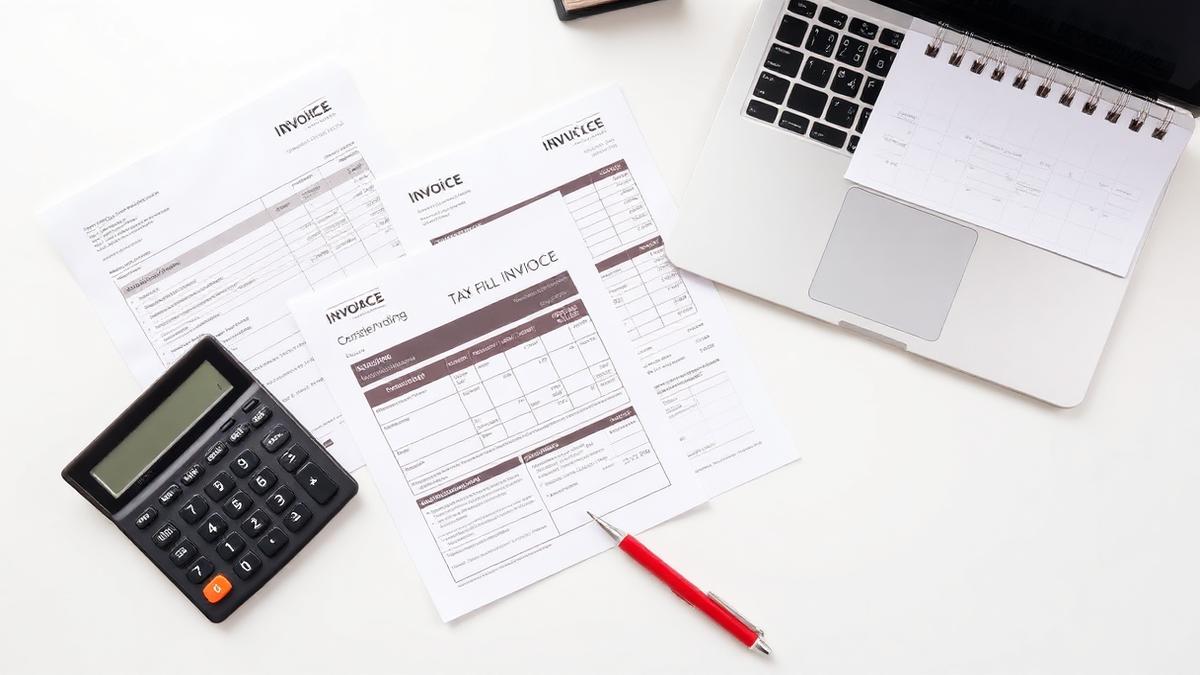
Getting invoicing and tax filings right is less glamorous than picking a company name, but it's where most of the actual financial risk in a small business lives. A missing invoice element can delay payment for weeks; a missed filing deadline can trigger penalties that dwarf the tax owed. This guide covers what US and UK founders need to get right, with the deadlines and thresholds that actually matter.
What Makes an Invoice Legally Valid: US
The US doesn't have a single federal "invoice law" the way the UK does for VAT invoices, but for an invoice to be enforceable, support your bookkeeping, and satisfy state sales tax requirements, it should include:
- Your business legal name and address
- Your customer's name and address
- A unique invoice number (sequential, no gaps — gaps look like hidden or deleted transactions in an audit)
- Invoice date and payment due date
- A clear description of goods/services provided
- Quantity, unit price, and total per line item
- Sales tax charged, itemized separately, if applicable, with the tax rate shown
- Total amount due and accepted payment methods
- Your EIN or business tax ID, which many B2B customers will require for their own 1099 reporting purposes
If you're registered to collect sales tax in a state, most states require the tax to be separately stated on the invoice, not bundled into the price — bundling it can create disputes about whether the tax was actually charged and remitted correctly.
What Makes an Invoice Legally Valid: UK
The UK has more prescriptive rules, especially once you're VAT-registered. A full VAT invoice must include:
- A unique, sequential invoice number
- Your business name, address, and VAT registration number
- The invoice date and the "time of supply" (tax point), which may differ from the invoice date
- Customer's name and address
- Description of goods/services
- Quantity and unit price (excluding VAT) for each item
- The rate of VAT charged per item (standard 20%, reduced 5%, zero 0%, or exempt)
- The total amount excluding VAT, total VAT, and total including VAT
- Any discount offered
For invoices under £250 (including VAT), you can issue a simplified VAT invoice, which drops some of the above requirements — useful for retail and small transactions.
If you're not VAT-registered, you must not charge VAT or include a VAT number on your invoices — this is a common and costly mistake for newly incorporated companies that assume VAT applies before they've actually registered.
VAT Invoices and the Reverse Charge
If you sell services to a VAT-registered business customer in another EU country (as a UK business, post-Brexit under the Northern Ireland protocol nuances aside, or as any EU business selling cross-border), you typically don't charge VAT yourself — instead, you issue an invoice marked "reverse charge applies" and the customer accounts for VAT on their own return at their local rate. Your invoice should state clearly: "Reverse charge: customer to account for VAT to HMRC" (or local equivalent phrasing).
The UK also applies a domestic reverse charge in construction (since March 2021) — if you're a VAT-registered subcontractor supplying construction services to another VAT-registered contractor (not the end customer), you don't charge VAT; your customer self-accounts for it. Getting this wrong in either direction — charging VAT when reverse charge should apply, or vice versa — creates real reconciliation headaches for both parties and can trigger HMRC queries.
Sales Tax vs. VAT: Different Systems, Different Traps
These are fundamentally different mechanisms, and conflating them is a frequent error for founders operating across US and UK/EU markets:
- US sales tax is a single-stage tax collected only at the final point of sale to the end consumer. Businesses buying for resale provide a resale certificate and don't pay sales tax on inputs. It varies by state, county, and even city (combined rates commonly range from 0% in states like Oregon or Delaware, to over 10% in parts of California, Louisiana, and Alabama).
- VAT is a multi-stage tax collected at every step of the supply chain, with businesses reclaiming the VAT they paid on inputs and remitting only the net VAT on the value they added. This is why VAT-registered businesses care intensely about receiving valid VAT invoices — no valid invoice generally means no input VAT reclaim.
A US business selling into the UK/EU may need to register for VAT (e.g., via the UK's low-value consignment rules or the EU's One Stop Shop/IOSS scheme for goods under €150) even without a physical presence, once selling directly to consumers there. A UK business selling into the US may trigger economic nexus sales tax obligations in individual states once crossing thresholds (commonly $100,000 in sales or 200 transactions per state, though a growing number of states have dropped the transaction-count trigger and use the revenue threshold alone).
Getting Paid Faster
Practical, tested tactics that actually move the needle on days-sales-outstanding:
- Invoice immediately, not at the end of the week or month — every day of delay is a day added to your payment cycle.
- Offer multiple payment methods — ACH/bank transfer and card at minimum in the US; Faster Payments and card in the UK. Card is faster for the customer but costs you 1.5%–3.5% in fees; weigh that against how much faster it actually gets you paid.
- Set clear payment terms upfront — Net 30 is standard, but Net 15 or "due on receipt" is increasingly normal for smaller invoices and new clients with no payment history.
- Use early payment discounts sparingly — "2/10 net 30" (2% off if paid within 10 days) works, but calculate whether the discount costs you more than short-term financing would.
- Automate reminders — most invoicing software can send automatic reminders 3 days before, on, and 7/14/30 days after the due date, without you having to remember or feel awkward chasing manually.
- Require deposits on large or new-client projects — 30–50% upfront is standard for project-based work, reducing your exposure if a client disappears mid-project.
Late Payment Rules
UK: The Late Payment of Commercial Debts (Interest) Act allows businesses to charge statutory interest of 8% above the Bank of England base rate on overdue B2B invoices, plus a fixed compensation fee (£40 for debts under £1,000, £70 for £1,000–£9,999.99, £100 for £10,000+). Most small businesses don't enforce this aggressively against ongoing clients, but it's useful leverage, and larger companies are increasingly required to report their payment practices publicly under the Reporting on Payment Practices Regulations — from April 2024 this reporting was extended to require reporting on retention payment practices in construction too.
US: There's no federal statutory interest rate for late B2B payments — it depends on what you specify in your contract/invoice terms. Include an explicit late fee clause (e.g., "1.5% per month on overdue balances") on every invoice and in your contracts, because without a pre-agreed term, you generally can't add one retroactively and expect it to hold up.
Filing Calendar: US LLC, US C-Corp, and UK Ltd
| Entity | Filing | Deadline |
|---|---|---|
| US LLC (multi-member, default) | Form 1065 (Partnership return) | March 15 (extension to Sept 15) |
| US LLC (single-member, foreign-owned) | Form 5472 + pro forma 1120 | April 15 (extension to Oct 15) |
| US LLC (electing S-Corp) | Form 1120-S | March 15 (extension to Sept 15) |
| US C-Corp | Form 1120 | April 15 for calendar-year filers (extension to Oct 15) |
| US — Sales tax returns | State-specific | Monthly/quarterly/annually depending on volume and state |
| US — Payroll tax deposits | Form 941 quarterly; deposits monthly/semi-weekly | 941 due end of month following quarter |
| US — 1099-NEC to contractors | Form 1099-NEC | January 31 |
| US — BOI report (FinCEN, if applicable) | Initial report | 30 days from formation (new entities); monitor rule changes |
| UK Ltd — Corporation Tax registration | CT41G/online registration | Within 3 months of starting to trade |
| UK Ltd — Company Tax Return (CT600) | CT600 | 12 months after accounting period end |
| UK Ltd — Corporation Tax payment | Payment | 9 months and 1 day after accounting period end |
| UK Ltd — Annual accounts to Companies House | Statutory accounts | 9 months after accounting reference date |
| UK Ltd — Confirmation statement | CS01 | Within 14 days of review period end (annually) |
| UK Ltd — VAT returns (if registered) | VAT return | 1 month + 7 days after each VAT quarter end |
| UK Ltd — PAYE/RTI | Full Payment Submission | On or before each payday |
Penalties Worth Knowing
- US Form 5472 late filing: $25,000 minimum penalty per form, even with zero tax due — this catches non-resident LLC owners off guard more than almost any other US filing.
- US late Corporate return (1120/1120-S): generally 5% of unpaid tax per month, up to 25%, with separate per-shareholder monthly penalties for S-Corps regardless of tax owed.
- UK late Company Tax Return: £100 if up to 3 months late, rising to £200 after that, plus tax-geared penalties (10% of unpaid tax) if more than 6 and 12 months late.
- UK late Companies House accounts: £150 if up to 1 month late, up to £1,500 if more than 6 months late for a private company — and penalties double if you're late two years running.
- UK late confirmation statement: no automatic fixed fine, but persistent failure risks the company being struck off the register.
- UK late VAT return/payment: under the points-based penalty system introduced in January 2023, you accrue a point per late submission, with a financial penalty (£200) once you hit the threshold (4 points for quarterly filers), plus separate late-payment interest.
Records Retention
- US: Keep records supporting income, deductions, and credits for at least 3 years from filing, but 6 years if you underreported income by more than 25%, and indefinitely for records related to property/asset basis (equipment, real estate) until you dispose of the asset plus the standard retention period after.
- UK: Sole traders/self-assessment — 5 years after the 31 January submission deadline for the relevant tax year. Limited companies — 6 years from the end of the last company financial year they relate to, longer if records relate to a transaction spanning more than one accounting period, or if HMRC has opened an enquiry.
- Keep digital copies at minimum — HMRC's Making Tax Digital rules already expect digital record-keeping for VAT, and this scope is expanding to income tax self-assessment for many taxpayers from April 2026.
FAQ
Do I need to charge sales tax if I only sell online? Yes, if you have nexus in the buyer's state — physical (inventory, employees) or economic (crossing the state's revenue/transaction threshold). Online-only doesn't exempt you from sales tax obligations.
What's the difference between an invoice and a receipt? An invoice requests payment for goods/services already delivered or about to be; a receipt confirms payment has already been made. You typically need both — the invoice as the initial demand, the receipt as proof of settlement.
Can I invoice in a foreign currency? Yes, but note the exchange rate used and date on the invoice, since your bookkeeping and tax filings generally need figures converted to your home currency at the rate on the transaction date (or an approved average-rate method).
What happens if I forget to register for VAT on time? HMRC can charge a penalty based on how much VAT you should have charged and how late the registration was, and you may owe VAT on sales made during the period you should have been registered, even if you didn't charge customers for it at the time.
Is Form 5472 really required even if my LLC made no money? Yes — foreign-owned single-member LLCs (treated as disregarded entities) still must file Form 5472 with a pro forma 1120 annually if there were any reportable transactions with the foreign owner, and even minor recordkeeping omissions can trigger the $25,000 penalty.
How quickly must I pay an invoice I receive, if there's no stated due date? UK law implies a default 30-day payment term for B2B contracts with no agreed term. In the US, no universal default exists — check your state's prompt payment laws if it's a government contract, otherwise it's governed by whatever was reasonably understood between the parties.
Should I use the same invoice numbering across all clients? Yes — sequential numbering across your entire business (not restarted per client) is what tax authorities and auditors expect; restarting numbering per client or per year without a clear system creates duplicate-looking invoice numbers that complicate reconciliation.
This article is for general informational purposes only and does not constitute legal, tax, or accounting advice. Consult a licensed professional about your specific situation.
Ready to start your company?
Launch in the US, UK, Canada, or Australia with Bizvee — formation, banking support, bookkeeping and filings.